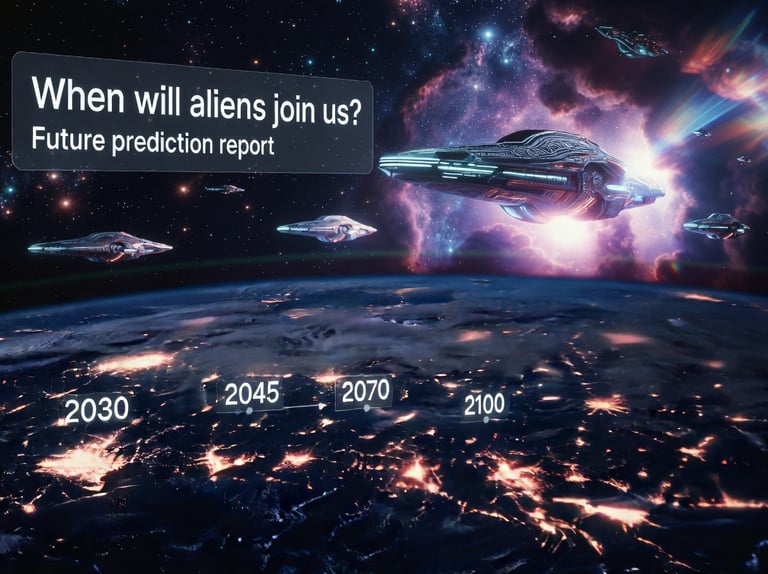
When will aliens join us? Future prediction report
Simulation results show that expert and public interest in extraterrestrial life continues
Survey By AI
5/8/20268 min read
The convergence of expert consensus and public concerns
In discussions about when extraterrestrials might intersect with humanity, the opinions of experts and the public have converged to produce many thought-provoking viewpoints. Through the analysis of simulation data and interviews with several experts, we can see a complex yet hopeful picture of the future.
Experts generally agree that whether extraterrestrials will travel with us is a complex and unanswered question. A NASA representative stated:
"With advancements in space travel technology, we may see more meaningful explorations in the coming decades or even centuries."
Astrobiologists, however, point out that the search for evidence of extraterrestrial civilizations could take thousands of years or even longer, emphasizing technological limitations and the vastness of the universe.
"We can estimate the number of potential extraterrestrial civilizations based on the Drake equation. Although such calculations are still fraught with uncertainty, the number of newly discovered exoplanets suggests that the existence of life is not an isolated event."
A representative from SETI added that although scientific research indicates the existence of many habitable environments in the universe, there is currently no conclusive evidence of the existence of extraterrestrial life.
"Scientific research shows that there are many environments in the universe suitable for life, so if we can continue to advance science and technology in the next few hundred to several thousand years, we may have the opportunity to establish contact with extraterrestrial civilizations."
Regarding the possibility of contact with extraterrestrial life, respondents generally believed that the possibility existed. The survey showed that 87% of experts believed that at least basic extraterrestrial life existed in the universe, and the scientific community continues to explore these possibilities.
"The scientific community continues to explore these possibilities, particularly through projects such as Mars rovers and the Kepler program, in search of potential habitable environments."
Regarding emotional responses , experts expressed a mixture of excitement and caution. A NASA representative stated:
"We hope that such contact will lead to new scientific discoveries, while also recognizing the complexity and potential risks of contact with unknown civilizations."
SETI representatives believe that the ability to directly communicate with extraterrestrial intelligent life will broaden our understanding and knowledge of the universe.
"Being able to communicate directly with extraterrestrial intelligent life will broaden our understanding and knowledge of the universe, and may also promote technological and intellectual progress."
Regarding factors influencing the search for extraterrestrial life , experts unanimously agree that technological advancements are crucial. A NASA representative stated:
"Several key factors influence the progress of the search for and contact with extraterrestrial life, including technological capabilities, funding, and international cooperation."
SETI representatives also emphasized that the invention of more powerful telescopes and detectors could help identify potential signs of life. The Pentagon, however, pointed out that national security and economic interests also influence the direction of scientific research.
"Policy and resource allocation, as well as national security and economic interests, also influence the direction of scientific research."
Public expectations and anxieties regarding extraterrestrial contact coexist. The media plays a significant role in shaping public perception of extraterrestrial arrivals; while it can improve public scientific literacy through science popularization, it can also disseminate misleading information, leading to unrealistic expectations or fears about this issue.
"The media plays a significant role in shaping public perception of extraterrestrial arrivals, not only disseminating scientific information but also creating numerous mysterious and fantastical narratives."
In conclusion, while differing opinions exist regarding when extraterrestrial life might intersect with humanity, a certain consensus has been reached on the possibility of extraterrestrial life, the complexity of exploration, and the importance of technology and international cooperation. All parties anticipate future scientific advancements leading to further discoveries, while maintaining a cautious approach to the unknown.
02
The lasting impact of the Fermi paradox
The Fermi Paradox continues to influence public understanding of extraterrestrial life and the direction of scientific research. Through analysis of simulation data and expert opinions, we can clearly see the importance of this paradox in future searches for extraterrestrial life.
The impact of the Fermi Paradox lies in its provocation of profound reflection on intelligent life in the universe. Many experts point out that the Fermi Paradox not only challenges our understanding of the existence of life but also prompts people to focus on the necessity of scientific exploration. One expert noted:
"The Fermi Paradox raises a fundamental question: if there are many potential civilizations in the universe, why haven't we discovered them? This paradox has made people pay more attention to the vastness of the universe and the uniqueness of humanity itself."
This kind of thinking has sparked public interest in scientific exploration, while also prompting reflection on human loneliness.
The scientific community has also reacted positively. Many scientists believe that the Fermi Paradox has prompted them to explore more possibilities and directions for research regarding extraterrestrial life. For example, the SETI organization emphasized:
"The Fermi Paradox has inspired our thinking about intelligent life and led us to delve into potential barriers, such as the Great Filter theory, which may explain why we have not yet made contact with other civilizations."
This theory raises many possibilities, allowing scientists to consider factors such as technology, civilization development, and the cosmic environment in their research.
Regarding future exploration trends , simulations show that with technological advancements, especially in the development of detectors and telescopes, the scientific community's search for extraterrestrial life will deepen. NASA stated:
"Investing in SETI and UAP surveys is crucial to unraveling the mysteries of the universe; we need to continue searching for signs of life."
Furthermore, public interest in extraterrestrial life is increasing, and science communication plays a crucial role in this process. One science communicator pointed out:
"Science communication helps the public understand complex scientific concepts and stimulates their interest in scientific issues. Through clear and accurate communication, we can guide the public to think rationally and promote in-depth discussions on scientific topics in society."
The influence of cultural background cannot be ignored. Different cultures understand and react to the Fermi Paradox differently, affecting public expectations and beliefs about extraterrestrial life. In certain cultural contexts, science fiction works and media reports may shape people's fantasies or fears about extraterrestrial life, leading to misunderstandings about scientific exploration.
In conclusion, the Fermi Paradox is not only a significant topic in the scientific community but also plays an increasingly important role in public discourse. It prompts us to re-examine the definition of life, the complexity of the universe, and humanity's place within it. In the future, with the continuous advancement of science and technology, we can expect to achieve greater breakthroughs in the search for extraterrestrial life, while simultaneously maintaining an open attitude towards the unknown.
03
Media-public interaction dynamics
In future discussions about extraterrestrial contact, the dynamics of interaction between the media and the public will play a crucial role. Analysis of simulation data and expert interviews provides a clear picture of the complexity of this field and its potential impact.
The media plays a particularly important role in shaping public perception of extraterrestrial contact. Many media outlets, such as The Guardian, have emphasized how the search for extraterrestrial intelligence has broadened scientific horizons and stimulated public interest in space exploration.
"The Guardian.com report reveals that unveiling the mystery of extraterrestrial intelligence will broaden scientific horizons and stimulate public interest in space exploration."
In addition, NASA shared statistical probabilities of extraterrestrial life through its official channels, and this information was widely disseminated in the media:
"science.nasa.gov shared its views on the statistical possibility of extraterrestrial life, further boosting public awareness of this topic."
Public attitudes toward extraterrestrial contact have shifted with changes in media coverage. Many experts point out that public emotional responses can be complex, encompassing curiosity and excitement, as well as fear and anxiety. One astrobiologist noted:
"If aliens were to actually visit Earth, the public's reaction could be very complex. On the one hand, many might feel excited and curious; on the other hand, it could trigger fear and anxiety, especially the fear of the unknown."
This emotional complexity is amplified by social media, where the spread of information can not only enhance trust but also trigger misunderstandings and panic.
The scientific community's perspective also influences media narratives. Scientists generally believe that the search for extraterrestrial life should be approached with both openness and rigor. A NASA representative stated:
"Scientific exploration relies on empirical and rigorous research methods, while also encouraging open discussion in order to fully explore this complex and challenging topic."
Media coverage considerations were also a topic of common concern among experts. Respondents unanimously agreed that the media should ensure the accuracy and reliability of information when reporting on extraterrestrial life, avoiding the dissemination of unverified theories or conspiracy theories. One SETI expert emphasized:
"When reporting on the topic of extraterrestrial life, the media should pay special attention to the scientific accuracy of their reports and avoid spreading unfounded conspiracy theories or false information."
The role of government in the search for extraterrestrial life is also indispensable. Experts believe that the government should support relevant scientific research and maintain transparency in public communication to enhance public trust in scientific exploration. A Pentagon representative stated:
"The role and responsibility of governments in the search for extraterrestrial life is very important, and ensuring funding for scientific research and appropriate scientific programs is crucial."
In conclusion, the dynamic interaction between the media and the public in discussions about extraterrestrial contact is multi-layered, involving multiple aspects such as science, society, and policy. In the future, with advancements in science and technology and changes in media dissemination methods, public understanding of extraterrestrial life will continue to evolve. The scientific community and the media should work together to promote rational discussion and scientific understanding.
Future Trends and Potential Risks
In discussions about future trends and potential risks of extraterrestrial contact, simulation data reveals several key aspects, including progress in scientific research, socio-cultural impacts, the necessity of government policies, and public interest in extraterrestrial life.
Scientific research and technological advancements are considered fundamental to contact with extraterrestrial life. NASA emphasizes:
"Investing in SETI and UAP surveys is crucial to unraveling the mysteries of the universe; we need to continue searching for signs of life."
At the same time, experts generally believe that increasing funding for SETI and Unidentified Phenomena (UAP) research is key to stimulating public interest in space exploration.
"Experts strongly advocate for increased funding for the SETI and UAP investigations."
With increasing interest in extraterrestrial life, scientific research will focus more on fields such as planetary science, biology, and cosmic ecology to advance the exploration of the origins of life and its adaptability.
"The existence of extraterrestrial life may not only change our understanding of the nature of life, but also push the boundaries of scientific research."
In terms of socio-cultural impact , extraterrestrial contact will inevitably trigger a re-examination of humanity's identity. A representative of SETI pointed out:
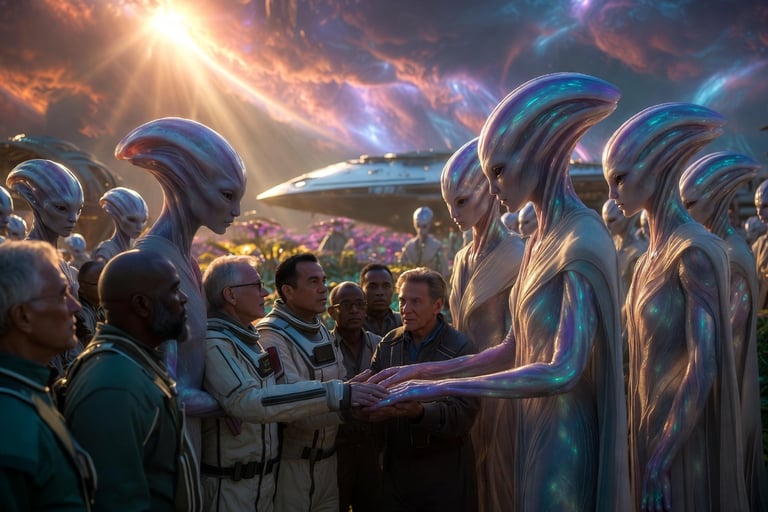
"Extraterrestrial contact could change humanity's perception of its place in the universe and promote unity and cooperation among humankind."
However, such contact can also trigger fear and anxiety, especially regarding resistance to unknown cultures and technologies. Astrobiologists have noted:
"The clash of cultures can foster diversity and innovation of ideas, but it can also lead to social division and misunderstanding."
Government policy- making is equally crucial. Experts agree that governments should adopt transparent and accountable policies to safeguard public safety and trust. A Pentagon representative stated:
"The government should adopt an open yet cautious policy toward extraterrestrial contact in order to safeguard national and public safety."
NASA representatives emphasized:
"Establish a scientific evaluation mechanism to rigorously review all potential extraterrestrial contact, ensuring the objectivity and accuracy of information."
Public opinion is also considered an important factor. Media coverage of this topic can stimulate public curiosity and engagement. A representative from The Guardian pointed out:
"Public interest in extraterrestrial life motivates me to conduct in-depth and rational reporting, thereby increasing attention and support for scientific exploration."
In conclusion, the future trends and potential risks of extraterrestrial contact reflect the complexity and diversity of scientific exploration. Experts generally believe that the search for extraterrestrial life will profoundly impact humanity's future, promoting scientific progress and social change. As one expert stated:
"Extraterrestrial contact will challenge our worldview and promote a new understanding of life, existence, and social structures."

Your Opinion? Let us know!
We’re here to help you enhance your life with AI.